

Some 50 years after the war ended in Vietnam, communities in Quang Tri are still living with the legacy of one of the 20th centuries longest conflicts.
Quang Tri experienced some of the heaviest bombing during the conflict. Available U.S. bombing data shows that more than 15,400 cluster munition bombing sorties were conducted across present-day Quang Tri Province, accounting for around a quarter of all such sorties dropped in Vietnam.
Large numbers of the submunitions from these sorties failed to detonate on impact, and an estimated 6,110 square kilometres of the province, almost half its land area, remains contaminated today.
In 2014, the province introduced the Quang Tri Integrated Survey and Clearance Approach, bringing provincial authorities, mine action operators and donors together within a shared framework for survey, clearance and prioritisation.
A framework built on partnership
Rather than representing a single project, the partnership established a more coordinated way of planning and delivering mine action, built on shared information management, evidence-based decision-making and close collaboration with provincial authorities.
Over time, this approach has become the foundation of Quang Tri’s mine action response and has supported the province’s wider ambition of becoming a ‘Safe Province’ by 2035.
A Database Unit then set up in 2012 gave the province a centralised information system for the first time and the introduction of the Cluster Munition Remnants Survey the same year added a systematic method for identifying contaminated land.
Together, these building blocks became the foundation of the integrated approach, later documented and shared as a model for evidence-based mine action.
A decade of progress
Over the past decade, this approach has delivered substantial results:
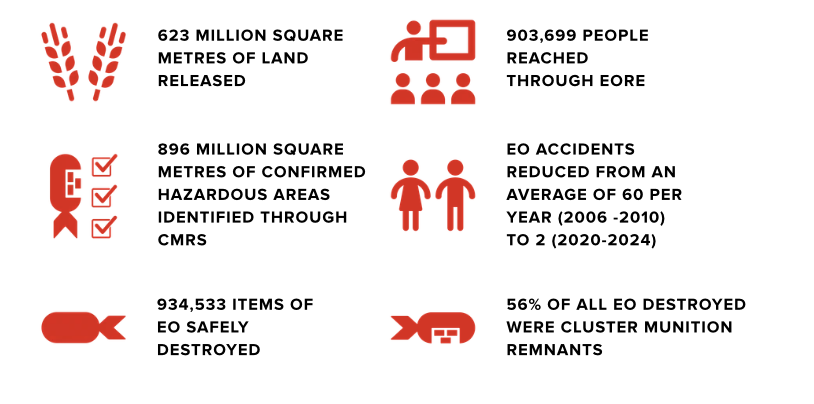
The report also documents the far wider impact of this work through community case studies, including communities in Cu Nam and Vinh Ninh, where the release of contaminated land has supported agriculture, infrastructure, private investment and improved livelihoods.
Together, these achievements reflect sustained investment in evidence-based survey, prioritised clearance and long-term partnership between provincial authorities, national institutions, mine action operators and donors.
This report lays out the significant progress made over the past decade to rid Quang Tri Province of the devastating impact of cluster munitions and other remnants of war.
Such progress is no coincidence: it is the result of a successful and sustained partnership between MAG, Vietnamese authorities, and international donors.
We are very grateful to all our partners for enabling us to achieve our joint objectives throughout this decade.
We know our work is not yet done and we look forward to continuing our collaboration until Vietnam can finally be free of this deadly legacy.
Sarah GoringMAG Country Director, Vietnam
With thanks to the Government of Canada and the Government of New Zealand for supporting the publication of this report.


