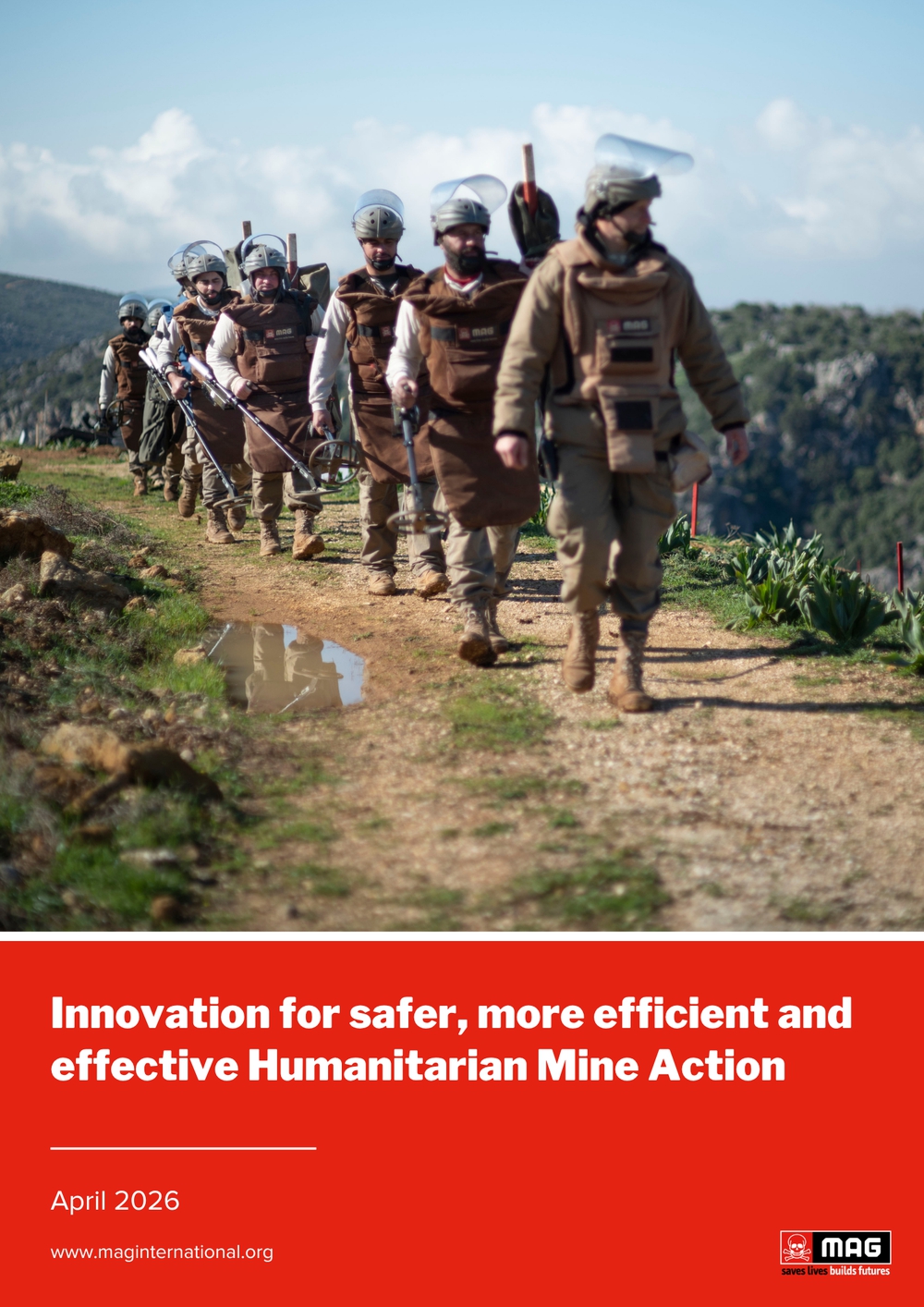

At MAG, we are exploring new technologies to make landmine clearance faster, safer, and more efficient for communities living with explosive remnants of war and the fear they create.
For more than 35 years, we have worked in areas contaminated by landmines, unexploded ordnance and unsafe weapons stockpiles. While clearance methods have improved dramatically, major operational challenges still slow the pace of returning safe land to communities.
Our Programme Quality Team have highlighted six key areas where MAG is exploring new innovative technologies to improve our operations – ultimately saving and protecting more lives...
More targeted mine action
One of the most persistent challenges is knowing where hazardous threats lie in wait. Contamination is often widespread, poorly recorded, and in hard-to-access areas. Traditional survey methods usually require teams to enter hazardous environments to locate unexploded ordnance.
We are integrating satellite imagery, remote sensing and geospatial analysis to better predict where contamination is likely to be, these tools are being merged with machine learning and Artificial Intelligence. This helps direct resources to the areas of greatest risk and reduces unnecessary exposure for colleagues. In practice, more targeted operations mean faster response and safer deployment of teams, from the outset and throughout.
Reducing false alarms on the ground
Most detector signals come from scrap metal, shrapnel, or debris – not explosives. As a result, deminers must excavate a high volume of signals to determine whether a genuine threat exists, slowing clearance operations.
We are now exploring new sensor technologies that are better equipped to distinguish between threats and harmless objects. This could reduce ‘false positives’, unnecessary excavation, improving productivity and cost efficiency.
Smarter mechanical systems
Mechanical assets already play an important role in preparing land for clearance activities and reducing risk. However, as they are often manually operated with relatively unsophisticated remote controls, they sometimes lead to uneven coverage or missed areas.
Recently, MAG has been exploring semi-autonomous guidance systems that allow machines to follow pre-defined routes or boundaries to improve consistency and accuracy, and reduce gaps or overlaps in treated ground.
Safer excavation methods
Excavation is one of the most hazardous stages of mine action, with serious risks even under strict safety procedures, especially in complex environments like urban areas with destroyed buildings and rubble.
We are exploring hybrid approaches combining human oversight with remote technologies. By using cost effective off-the-shelf machines with remote capabilities we can keep our staff safe in the dense urban areas of recent conflicts.
(photo taken during a controlled, safe setup)
Safe and scalable approaches to weapons and ammunition destruction
Safe disposal of weapons and ammunition is challenging, with large stockpiles often being unstable and slow to destroy in a cost effective and environmentally friendly way.
MAG is exploring more scalable, modular approaches and improved demilitarisation techniques to speed up safe destruction and support national authorities. With this MAG will pair Ammunition Technical Officer training to enable national authorities to efficiently manage their stockpiles for the future.
Smarter use of data and knowledge
Across all of this work sits a growing need to better manage knowledge and data.
MAG has been exploring how digital tools and artificial intelligence can make knowledge more accessible and use data more effectively, such as by using AI knowledge assistants to allow staff to query standards and procedures, or mapping population movement data to better deliver timely risk education messaging.
The exploration of these innovations is grounded in the needs and experiences of communities living with contamination. By investing in these technologies, MAG teams are working to reduce danger at every stage of our operations and support communities as they recover from conflict and explosive remnants of war.
Across all six areas, our focus remains the same: reduce risk to our teams and return safe land to communities efficiently and effectively.
For any queries relating to MAG’s innovation work, please contact research.development@maginternational.org