

In the Caribbean, a groundbreaking initiative is transforming ammunition management capacity. As part of a MAG and CARICOM IMPACS project funded by the U.S. State Department, the Caribbean has conducted the first-ever regional validation course for personnel working with the International Ammunition Technical Guidelines.
This effort marks a major step toward establishing a shared, professionalized regional roster of ammunition specialists that enhances preparedness, prevents accidents and reduces illicit ammunition diversion.
The validation course was facilitated by the Geneva International Centre for Humanitarian Demining (GICHD) Ammunition Management Advisory Team (AMAT). AMAT, established in 2019, is a joint initiative of GICHD, the United Nations Office of Disarmament Affairs and its UN SaferGuard Programme. AMAT has previously conducted validation courses for personnel from around the world for the UN SaferGuard Global Roster of Experts.
From recommendation to real-world practice
The idea for the course is a new concept developed under the Global Framework for Through-Life Conventional Ammunition Management, which highlights the need for practical, scalable ways to validate and deploy ammunition expertise. MAG and CARICOM IMPACS are the first globally to take this recommendation and turn it into real-world practice.
In the Caribbean, retaining independent fully trained ammunition specialists in relatively small state agencies across every member state is a difficult task. For this reason, the project emphasizes building a regional roster, a shared pool of validated experts available to support in ammunition management and prevent illicit ammunition diversion.
Strengthening national systems and reducing risk
Managing ammunition safely and securely is essential for preventing unplanned explosions at munitions sites and illicit diversion to criminal groups. The roster will be owned and maintained by CARICOM IMPACS and aims to provide expertise that is more preventative than reactive.
The existing global roster primarily supports quick response missions following accidents, while this regional roster can intervene earlier to strengthen national systems and reduce risks.
How the training works
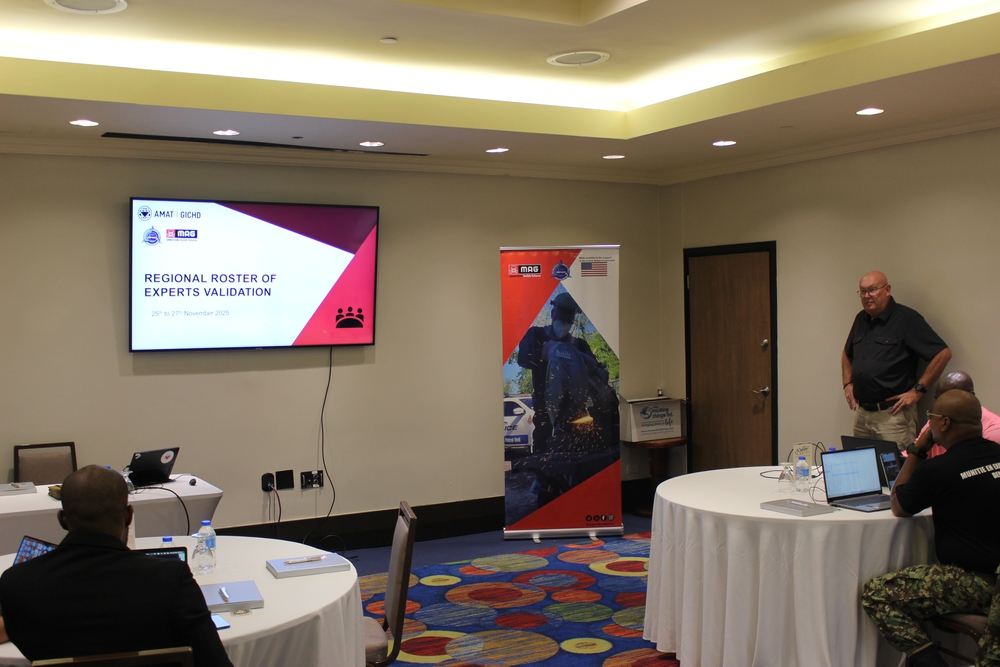
The course blended individual assessments with group-based exercises, offering a realistic view of how specialists operate in the field. It was facilitated by a joint team: three facilitators from GICHD and MAG who evaluated participants at the end of each day across three days.
Participants were assessed against two qualification tiers:
- Expert Level 1 – Fully experienced personnel capable of independently deploying on technical assistance missions.
- Expert Level 2 – Emerging experts who will accompany experienced specialists on missions to build additional experience.
This tiered system creates a sustainable cycle of mentorship and professional growth, ensuring the roster remains dynamic and future focused.
Ensuring standardised, evolving best practice
The course is built around the International Ammunition Technical Guidelines, first published in 2011 and currently undergoing revision, with Version 4 expected in 2026.
The guidelines are a living document, reflecting the reality that safe ammunition management is continually evolving as new technologies, incidents and lessons learned emerge.
The document covers the full through-life management of ammunition, from procurement and storage to transport and disposal to ensure comprehensive, standardised practices that reduce risks of illicit ammunition diversion.
Building safer communities across the Caribbean and beyond
Although this validation course was designed for the Caribbean, its implications are global. AMAT and the United Nations Office of Disarmament Affairs plan to expand the approach to other regions, enabling consistent professional standards and broader access to trained experts who can support state authorities in strengthening ammunition safety and security.
With more mentoring and experience, the five personnel from the Caribbean will ultimately learn the skills and gain the necessary experience to manage ammunition stockpiles and provide support across the region independently. The personnel could eventually take part in the validation to become members of the UN SaferGuardGlobal Roster of Experts which currently has no representation from the region.
By piloting this first course, MAG, CARICOM IMPACS and the U.S. State Department are preventing illicit ammunition diversion to criminal groups, enhancing regional security and ensuring responsible ammunition stockpile management.


